The Context for Christ’s Great Accomplishments
and the Spread of the Gospel
“For Christ’s great accomplishments to be carried out, there was the need for the Roman Empire to be established.” (The World Situation and God’s Move, p. 10)
God was incarnated as a man, Jesus Christ, during the reign of the first Roman emperor, Caesar Augustus (27 B.C.-A.D. 14). The reign of Augustus initiated a period called the Pax Romana, a period of relative peace, in which the Roman Empire experienced little large-scale conflict. Also, because such a large area of land in Europe and the Middle East was under one rule, people were free to cross the borders of many provinces without restrictions and in a situation of order. The use of ships on the Mediterranean Sea and the extensive Roman road network facilitated travel.
It was God’s ordination that the Roman Empire should be in control of the Mediterranean area during the time of Christ. The order which Rome brought to that warring region made it possible for the Lord Jesus to be born peacefully into mankind. The Roman method of capital punishment, crucifixion, made possible the fulfillment of the prophecies concerning His death.
The spread of the gospel after the resurrection and ascension of Christ was greatly facilitated by the common language, the single rule, the roads, and the domestic order that Rome established.
Greek was the language of the educated classes. The New Testament, though written almost entirely by Jews—Luke was the only exception—was written in Greek, not Hebrew. Even before the rise of the Roman Empire, about three centuries before Christ, the Hebrew Old Testament was translated into Greek. This version, called the Septuagint, was translated by seventy scholars in Alexandria, Egypt. When the Lord Jesus was on earth, many times the Scriptures He quoted were from the Septuagint.The Roman Empire, then, was appointed by God to provide the situation in which redemption could be accomplished and the gospel spread. (The World Situation and God’s Move, pp. 10-12)
The gospel began to reach Europe in Paul’s second, third, and fourth journeys. During Paul’s second journey, as he and his co-workers were journeying through Asia after passing through Phrygia and Galatia, the Holy Spirit forbade them to speak the word in Asia. They went to Mysia and tried to go into Bithynia, but the Spirit of Jesus did not allow them. So they went to Troas, and there, Paul had a vision in the night.
A certain man, a Macedonian, was standing and entreating him and saying, Come over into Macedonia and help us. And when he had seen the vision, we immediately endeavored to go forth into Macedonia, concluding that God had called us to announce the gospel to them—Acts 16:9-10
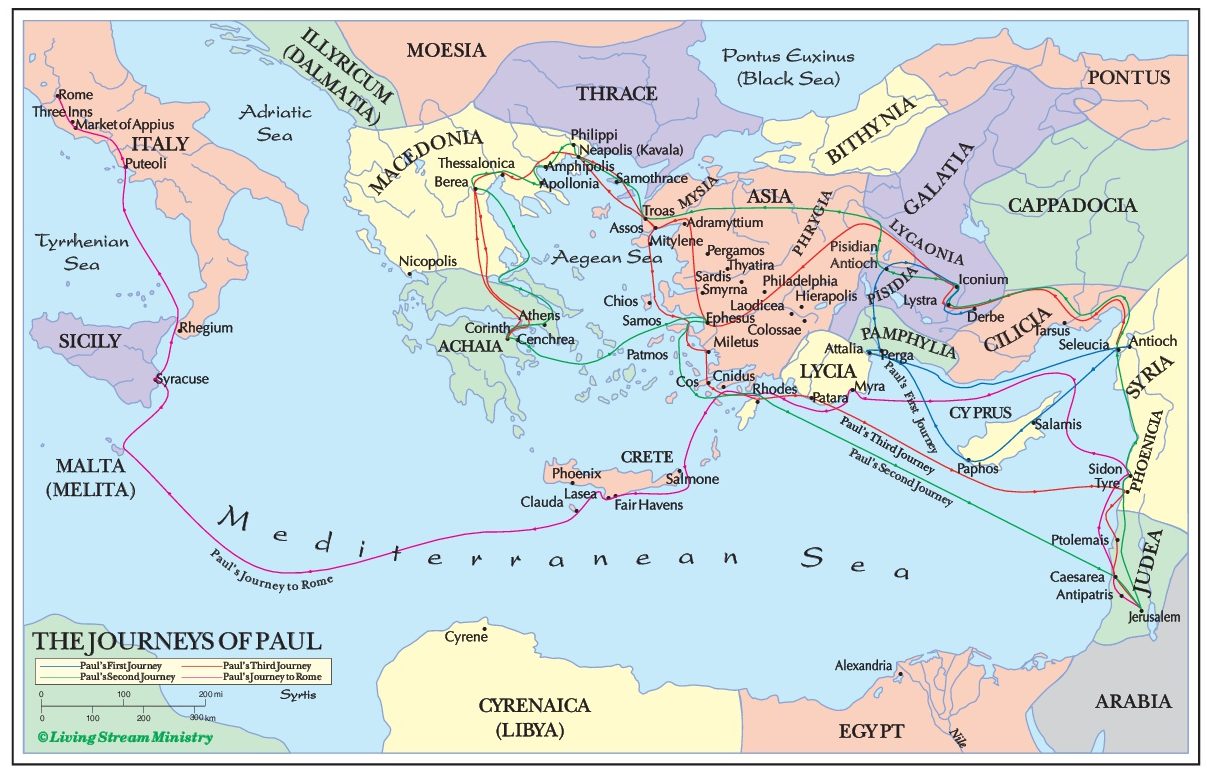
The Journeys of Paul | © Living Stream Ministry.
Used with permission. Do not duplicate.
Paul then went into Macedonia, to Philippi, a leading city in that part of the province, and there, Lydia and her household were baptized. Later, Paul and Silas were imprisoned in Philippi, but while praying and singing hymns of praise to God, an earthquake opened the prison doors, and they preached the gospel to the jailer. He and his household were also baptized.
From Philippi they travelled to Thessalonica, Berea, Athens (where Paul preached on the Areopagus), Corinth, and Ephesus (Acts 17—18). Paul went again to Ephesus on his third journey, through Macedonia and Greece to Troas (in Asia), and from there he journeyed back to Jerusalem, where he was eventually seized and bound by the Romans. On his fourth journey he experienced a storm and a shipwreck and eventually ended up in Rome, where he ministered until his martyrdom. During this period, Paul also expressed a desire to go to Spain.
From Paul’s time onward, the gospel spread throughout the Roman Empire, which covered much of southern and western Europe. Then as Brother Lee points out,
Satan followed. What God uses, Satan also comes along to use in order to cause damage. The emperors began to persecute the Christians, and countless numbers were martyred. Persecution, as we know, did not terminate the Christians; it rather helped them. Then Satan changed his strategy. Under the rule of Constantine the Great [A.D. 306-337] the Roman Empire made Christianity legal, and Christians had the full freedom of worship. Because of the favors he granted the Christians, thousands of pagans were baptized and became Christians in name. These were the tares spoken of in Matthew 13:24-30 that ruined Christianity.
Under his influence the Nicene Creed was drawn up (A.D. 325). He acted openly as head of the Church, which in his reign was first called Catholic; at the same time he kept his title of high priest of the heathen.
This ruin progressed from the fourth to the sixth centuries, by which time the papal system was fully established. With this the Roman Catholic Church reached its full development; it claimed to be the one, universal church (catholic means universal) and exercised worldly power over people and nations. No protest or dissent was tolerated. Over the centuries when it held sway, the Roman Catholic Church killed more genuine Christians than the pagan Roman Empire had killed. Under such a dark Church, the so-called Dark Ages were produced, lasting about ten centuries, from about A.D. 500 to 1500. (The World Situation and God’s Move, p. 12)
The empire ultimately declined, and the western Roman Empire fell in A.D. 476, but Europe was under the power of the Catholic Church for another one thousand years. This period, known as the Middle Ages, has been called the “Dark Ages,” and for this long period of time Europeans were kept under the authority of the worldly church without access to the Word of God.