The contents of this page are:
- The Lord’s Move in China
- Watchman Nee’s and Witness Lee’s Visits to Europe
- Brother Lee’s Visit to Europe in 1958
The Lord’s Move in China
One hundred years after the beginning of the Brethren movement, the Lord started something new in mainland China. In the eighteenth century the Moravian Brethren were on the continent of Europe. In the nineteenth century the Brethren were used by the Lord in England. A century later the Lord moved in the Far East. (The History of the Church and the Local Churches, p. 3)
Map showing the US, the UK, China, and Taiwan | © Amana Trust
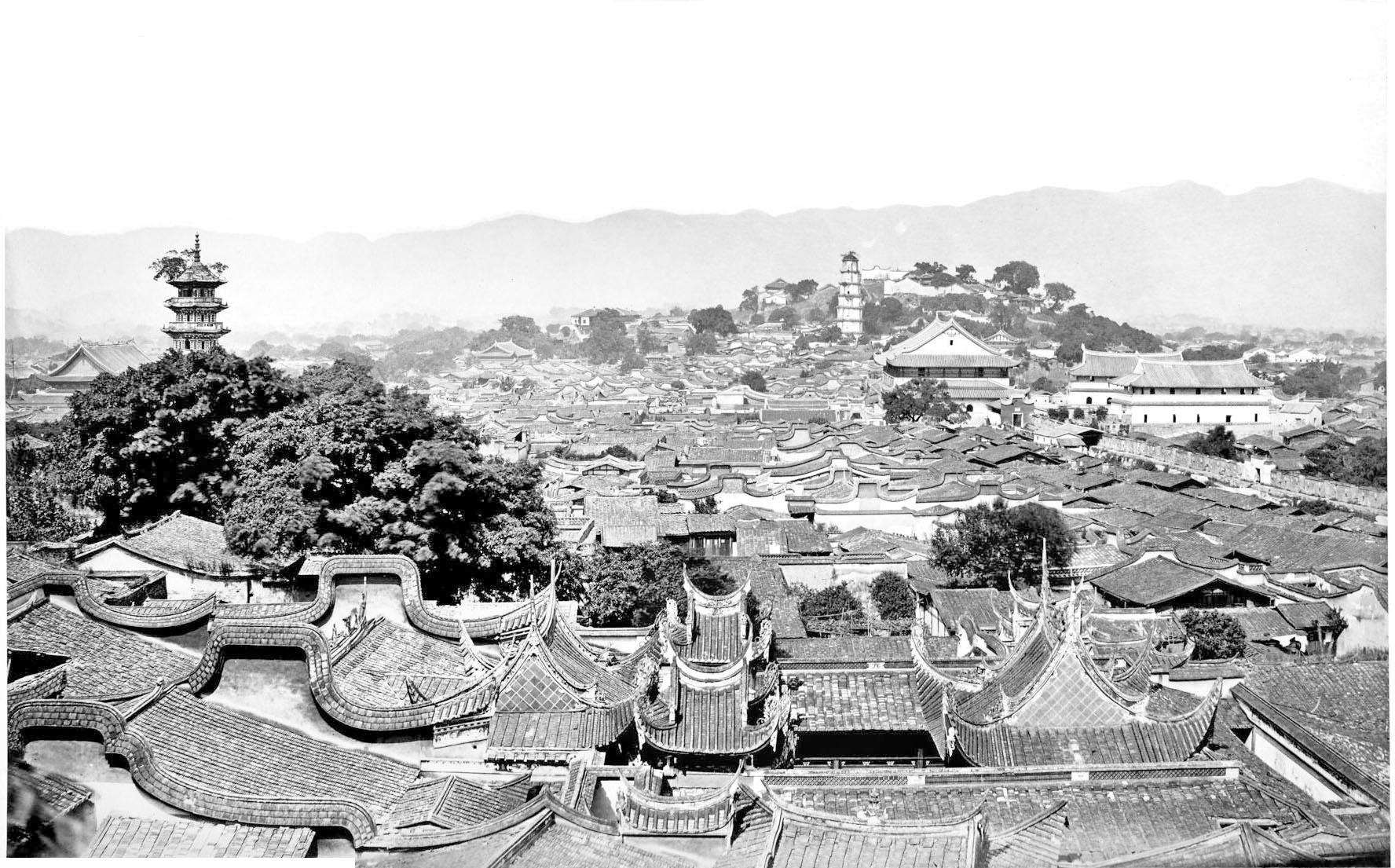
Missionaries from England brought the recovered truths to China, and in the 1920s the Lord raised up Brother Watchman Nee for His recovery. It was through Sister M. E. Barber, originally from Suffolk in England, that Brother Nee was introduced to the top spiritual writings, which conveyed the past centuries’ recovery of truth and experience.

Portrait of M. E. Barber | Source
Sister Barber was sent by the Church Missionary Society to Fukien (Fujian) province in China, where Brother Nee was.
While she was there, her co-missionaries fabricated a case against her because of their jealousy of her. Because of these false reports, the mission board called her back. She was a person who knew the Lord in a living way, and she was always exercising to learn the lessons of the cross. When she returned, she made a decision not to say a word in vindication of herself. She stayed in England for a number of years…[until] she was vindicated, and the board immediately made the decision to send her back.
Before that time, she began to know the way of the Lord concerning His church. She came in contact with D. M. Panton, who was a student of the great teacher Robert Govett. Brother Panton came to know the evils of denominationalism, and he met with a group of others outside of the denominations…After Miss Barber contacted D. M. Panton’s group, she became clear about denominations. Then she resigned from her post as a missionary in the Methodist mission. After much prayer she became clear that the Lord would send her back to China according to His leading and not through any mission. (The History of the Church and the Local Churches, pp. 39-40)
Sister Barber resigned from the mission and returned to China to live by faith. She was a deep person in the Lord and an important influence for Brother Nee. From her, he saw a pattern of one who lived Christ and also learned spiritual truths.
Brother Lee shares Brother Nee’s account to him regarding M. E. Barber in The History of the Church and the Local Churches:
Brother Nee came in contact with her soon after his conversion, and he received so much help from her…According to what Brother Nee told me, Sister Barber was a person who always lived in the presence of the Lord…She was a deep person in the Lord, and she composed a number of excellent hymns that are in our hymnal. All her hymns were very deep in the Lord. Furthermore, day by day she was waiting for the Lord’s coming back.
It was through M. E. Barber that he received the foundation of his spiritual life. Brother Nee would tell people that it was through a sister that he got saved, and it was also through a sister that he was edified. As a British person from the Western world, Sister Barber came to know the famous spiritual giants in Christianity at her time. Through Sister Barber, Brother Nee came to know the top spiritual books by people such as Robert Govett, D. M. Panton, and Jessie Penn-Lewis. The best publications on the exposition of the Bible and church history were introduced to Brother Nee through her. (pp. 40-42)
Brother Lee testified concerning Brother Nee:
The first meeting in the Lord’s recovery in China was in 1922 with Brother Nee in his hometown of Foochow [Fuzhou]. I am full of thanks to the Lord that in the first part of this century He gave Brother Nee as a gift to the Body. I was born in Christianity and raised up there. I even received my education in Christianity. In my seeking of the Lord, I passed through organized Christianity, fundamental Christianity, Brethren Christianity, and even Pentecostal Christianity. I also entered into the teachings of the inner-life Christians. In my entire life, I have never met a Christian who can compare with Brother Nee. I received the greatest and the highest help from him. He picked up good and helpful things from nearly every denomination, from every kind of Christian practice, and from all the seeking saints throughout the history of the church, and he passed them on to us. The first time I stayed with him, I realized that he was standing on the shoulders of many who had gone before him. (The History of the Church and the Local Churches, p. 36)
Witness Lee met Watchman Nee in 1932 and throughout the 1930s and 1940s they were co-workers in China, speaking the truth and raising up churches.
Watchman Nee’s and Witness Lee’s Visits to Europe
Brother Nee visited Europe on two occasions, in 1933 and 1938-1939.
Brother Nee went to visit the Plymouth Brethren in England in 1933. Before that time he had read many of the Brethren’s writings. Also, through Miss M. E. Barber, he became acquainted with the writings of Jessie Penn-Lewis and T. Austin-Sparks. When he went to visit the Brethren in 1933, he also went to visit Brother Austin-Sparks at Honor Oak in London.
Later, Brother Nee went to Europe again in 1938, and he stayed there for one and a half years to have more fellowship. Mostly he was with Brother Austin-Sparks’s group at Honor Oak. He was also invited to speak in some of the Scandinavian countries. In those one and a half years, he ministered mainly on the aspect of Christ as life because he realized that the people there were not ready to accept the aspect of the church in a practical way. The Normal Christian Life is a collection of the messages Brother Nee gave then. (The History of the Church and the Local Churches, pp. 102-103)
For a number of the saints who met Brother Nee in Europe at that time, their contact with him was life-changing (according to a brother’s conversations with some who had met Brother Nee). During Brother Nee’s visit, in July 1938 he was invited to the Keswick Convention, an annual gathering of Christians who emphasized the experience of the inner life.
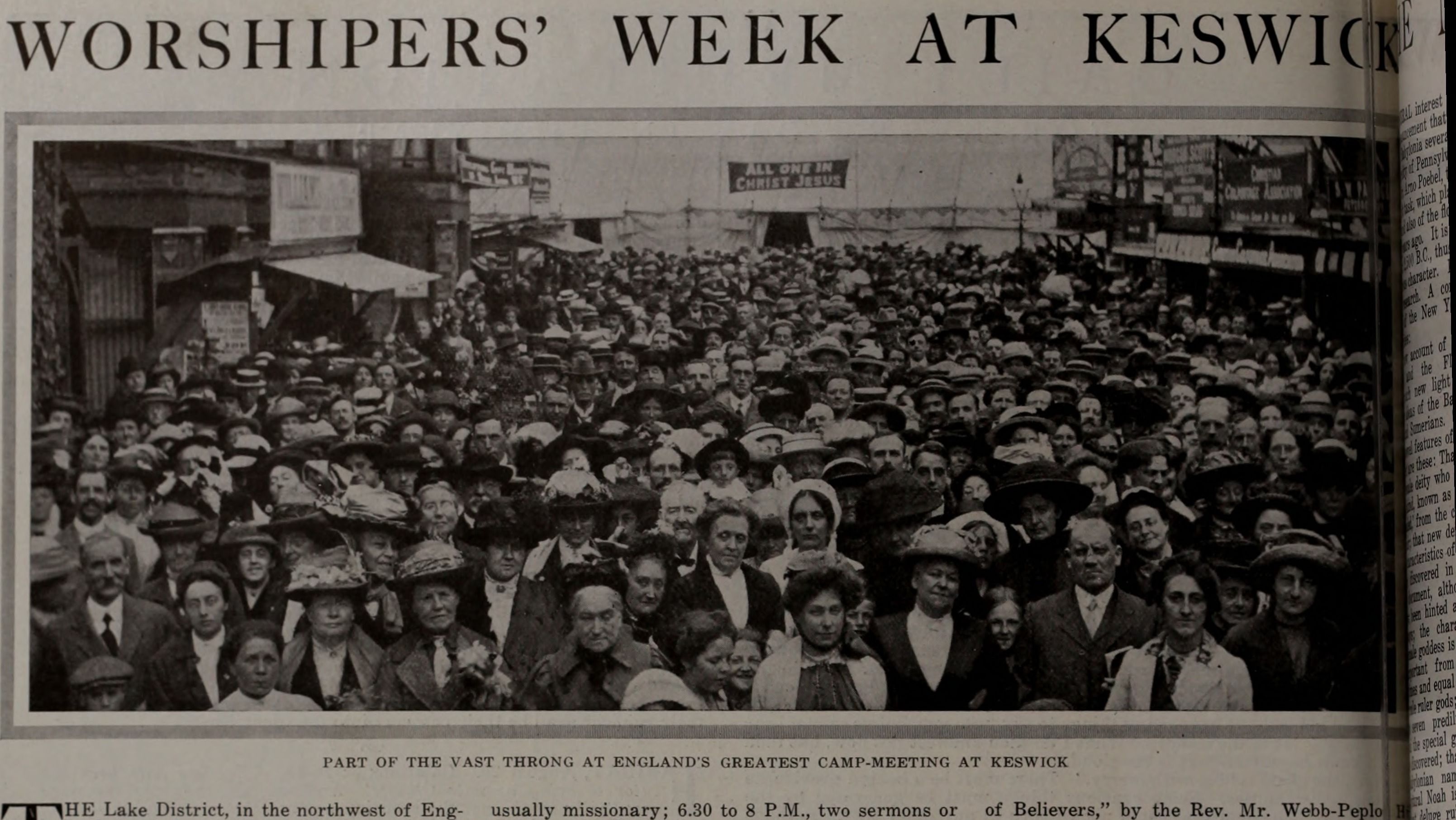
Keswick Convention, 1913 | Source
The account in Watchman Nee’s biography says regarding this event,
On July 22 he attended the Keswick Convention with Brother Sparks. In the morning a missionary meeting was held. The chairman of the meeting, Mr. W.H. Aldis, knowing Watchman was present at the meeting, asked him to offer prayer. He hesitated at first, but after checking with Sparks and being encouraged by him, he offered the following prayer: “The Lord reigneth. He is reigning, and He is Lord of all. Nothing can touch His authority. It is the spiritual forces that are out to destroy the interests of the Lord in China and Japan. We do not pray for Japan. We do not pray for China. But we pray for the interests of Thy Son in China and Japan. We do not blame any man. They are only tools in the hand of the enemy of the Lord. Lord, we stand in Thy will. Lord, shatter the kingdom of darkness. Lord, the persecution of Thy church is persecuting Thee.” This prayer was offered in the presence of a Japanese Christian at the time the great havoc of the invading Japanese army was increasing. The whole congregation was both captivated and deeply impressed by this prayer. (Watchman Nee—A Seer of the Divine Revelation in the Present Age, p. 204)
According to Brother Lee,
While Brother Nee was there, he also translated The Normal Christian Church Life from Chinese into English. He did that, of course, with a purpose. This book was translated in London while he was staying at Honor Oak. Miss Fishbacher [a missionary in China who had come into the church life there] helped him in this translation work. That book was printed by the bookroom of Brother Austin-Sparks. After it was published, it stirred up some problems. (The History of the Church and the Local Churches, p. 103)
Although it was printed by the bookroom at Honor Oak, T. Austin-Sparks was not entirely receptive to Brother Nee’s ministry on the practicality of the church.
During this time, Brother Nee testified to Witness Lee “that on the whole earth, there was only one group that could ‘echo’ what we had seen of the Body of Christ. That was Brother Austin-Sparks’s group. Brother Nee, however, said that there was a big ‘but.’ They saw something concerning the principle of the Body, but they did not see the practical side of the church life” (The History of the Church and the Local Churches, pp. 104-105).
[In the summer of 1939,] Brother Nee returned to China and had a conference on the Body of Christ…Furthermore, Brother Nee would minister to the whole church in Shanghai every Wednesday night. He also spent several mornings each week with his trainees…Brother Nee’s fellowship on the Body during that time was the most strategic work of his entire life.
Due to the exposure of the enemy’s subtlety through Brother Nee’s messages during those three years, the enemy caused a big turmoil in the church in Shanghai in 1942. Eventually, the church there was closed, and Brother Nee’s ministry was stopped for six years. (The History of the Church and the Local Churches, pp. 64-66)
At the same time, China was involved in World War II, and at the end of that war, China was plunged into a civil war that would last until the autumn of 1949. During the Communist takeover of China, Brother Nee sent Witness Lee to Taiwan to preserve and carry out the work of the ministry there.

Situation at the end of World War II | Source
Brother Lee’s Visit to Europe in 1958
Brother Lee continued to fellowship with T. Austin-Sparks and with saints in Scandinavia, and in 1958 Brother Lee went to Europe to visit Honor Oak. During this trip, before going to Europe, he also visited Japan and the US.
(For more on these other trips, please see The Perfecting of the Saints and the Building Up of the House of God, chs. 7—13.)
In England Brother Lee held a conference at Honor Oak and then went to Denmark for another conference. He reported shortly afterward that “of all the places we visited, Denmark had the most positive situation…We did not expect them to meet in their homes, but in a letter I received from them recently, they said they are now meeting in more than twenty homes” (The Perfecting of the Saints and the Building Up of the House of God, p. 109).
He continued, saying, “My overall impression is that there is a need in every place to build up God’s house so that the wandering believers can have a home. If there is another opportunity for me to speak with the children of God, I will say that the greatest need on earth today is to build up God’s house” (p. 109).
Brother Lee shared on the day before he left Honor Oak,
The ministry is for the local churches, not the local churches for the ministry. Regardless of how good, how spiritual, and how high one’s ministry is, it still must be for the local churches. Regardless of how degraded the local churches are, they are still the lampstands…As I walked down from the platform by myself, one of the elders there came to me and said that Brother Nee’s ministry concerning the church and its practicality had been rejected there twenty years ago. He said that the Lord had not forgotten this and sent me there twenty years later to remind them of the same thing. (The History of the Church and the Local Churches, p. 104)
The fellowship with Honor Oak, beginning in the 1930s, however, was eventually used by the Lord for the beginnings of the church life in the US. Brother Samuel Chang (Watchman Nee’s brother-in-law) moved to Los Angeles in 1959 and began to meet at Westmoreland Chapel. Westmoreland Chapel was connected with Honor Oak, and a number of the first saints in the church in Los Angeles began by meeting at Westmoreland. Brother Lee had also visited the US in 1958 (before he traveled to England) and had spoken at Westmoreland about eating Christ as the tree of life. Samuel Chang fellowshipped with the saints there about God’s view of the church and his own experience of the church life, infusing into them a burden for an expression of the church in Los Angeles (Reetzke, Recollection with Thanksgiving: A Brief History of the Beginnings of the Lord’s Recovery in the United States (2004), pp. 8-9). Eventually, after much and thorough prayer, the situation became clearer to the saints, and they began the first Lord’s table as the church in Los Angeles on Lord’s Day, May 27, 1962.
Soon after, Brother Lee moved to the US and ministered in English. From the 1960s onward, the ministry began to spread all over the earth and eventually returned to Europe.