Hungary, Poland, Romania, Czech Republic, Slovakia
In 1991 Brother Lee shares in The Central Line of the Divine Revelation:
Romans 10 says that faith comes out of hearing, and hearing comes out of preaching (vv. 14, 17), and preaching comes out of being sent (v. 15). Recently I received a letter from a dear brother who had just returned from a trip to eastern Europe to visit Czechoslovakia, Poland, and Hungary. The impression I received from this report is that there is the need for the preaching of what we believe. Those countries need our young people to go there to teach the people our belief, our faith. I do believe the Lord will afford us the way to go. We need to send a good number of young people to these countries. But where are the people who will go? The Lord said to Isaiah, “Whom shall I send? Who will go for us?” (Isa. 6:8). Would you answer, “Lord, I am here. I will go”? You do not need to care for your living. Jesus will feed you. Some of you can go to those countries to teach English. As you teach English to the people, you can teach them the truth, the faith, the belief, and the holy word that you have heard. If you would go there and take care of just ten people, I believe that in half a year you would bring all these ten to the Lord and into the truth. (pp. 153-154)
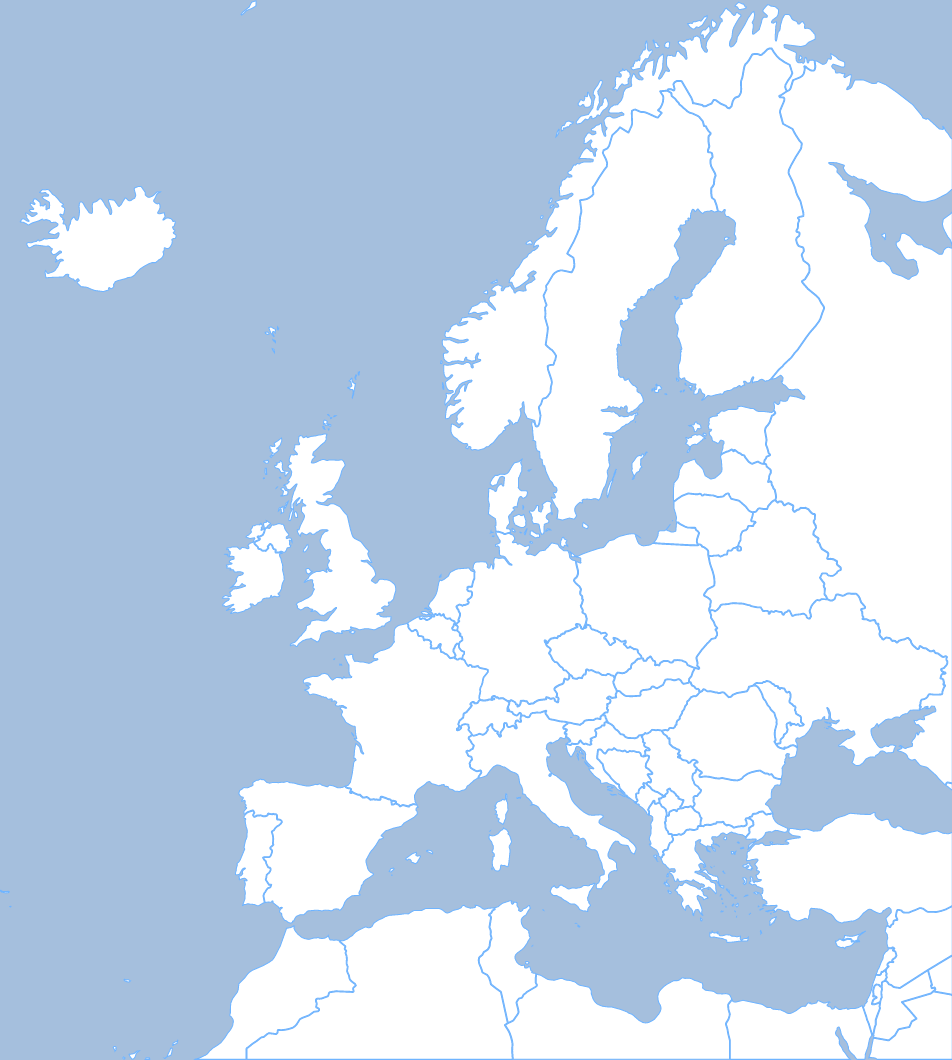
Map of Eastern and Central Europe showing Lampstands
(click on or hover over the map to view map labels)
The contents of this page are:
Hungary
Hungary has been a predominantly Christian country since the eleventh century. The Protestant Reformation had an important influence on the country in the sixteenth century. János Sylvester translated the Bible into Hungarian in 1541, Luther’s teachings reached Hungary by German settlers in the area that is now Slovakia, and later, Calvinism became widespread; however, the Catholic Habsburg Empire’s Counter-Reformation reversed these gains. The Battle of Mohács in 1526, largely seen as a turning point in Hungarian history, resulted in the division of the Kingdom of Hungary into three parts–the northwest was controlled by the Habsburgs, the central portion by the Turks, and the Principality of Transylvania to the east paid tribute to the Turks to remain semi-independent. The Turks did not enforce Islam on Transylvania with the result that there are still significant Protestant communities in the eastern part of Hungary. After the break-up of the Austro-Hungarian Empire during the First World War, Hungary became an independent country, and after the Second World War, it became a Communist country. Despite the government’s official policy of atheism and early persecution of Christians, a majority of Hungarians continued to believe in God.
The ministry first reached Hungary through a Hungarian brother who met brothers in Kent, Ohio, in 1985. He began translating ministry books in 1986 and continued to be supplied by Life-study tapes sent by a brother from the US. After the fall of Communism, two brothers from America and London went to Budapest in 1992 to find university students who could translate key ministry books, and the books begin to spread through Hungary. Saints from Taiwan and the US migrated there in the late 1990s and early 2000s and acquired an apartment for office, meeting, and hospitality purposes. Rhema began free literature distribution in 2003, and in 2005 the first Hungarian brother graduated from the FTTL. More saints from the US migrated to Budapest in 2009 and 2011 to continue Rhema work and to strengthen the Lord’s testimony. In 2012 ten saints attended the first Lord’s Day meeting in Budapest, in 2013 weekly prayer meetings for the brothers and sisters began, and in 2016 the saints held their first Lord’s table meeting.
The testimony in Hungary has been strengthened by regularly blending with saints from the Czech Republic and Slovakia and with all of Europe in the International Conference in Baarlo, Netherlands. A number of Hungarian saints have also attended the one-week trainings at Bower House, London.
As for the near future, our burden is to extend the boundaries of blending within the region to include localities like Zagreb, Croatia; Novi Sad, Serbia; Kosice, Slovakia; Timisoara, Romania; and Vienna, Austria. Based upon the openness and interest of some believers in other localities in the country, that is, in Szeged, Békés, and Debrecen, we are pursuing to help them to start meetings for reading the free ministry publications together so that the Lord would have a way to raise up lampstands in these localities in Hungary.
Poland
Poland was Christianized from the time of the “Baptism of Poland” (the baptism of the first ruler of the Polish state, Mieszko I and his court) in 966. Since the thirteenth century Poland has been a predominantly Catholic country. However, a significant number of Jews historically lived in Poland until World War II, during which a large number of Polish Jews perished in the Holocaust. The Hussites from Bohemia (in the present-day Czech Republic) first introduced Protestant ideas to Poland and despite gaining a significant number of people, Protestantism in Poland was almost completely stamped out by the Catholic Counter-Reformation. Polish identity has been historically wrapped up with Catholicism, and even under Communism, Poland was never as atheistic as other countries in the Soviet bloc. Because the Catholic Church in Poland has been a major factor in dissent to foreign rule and also to Communism, national identity in Poland is closely identified with being Catholic.
However, the Lord found a good number of saints who chose the way of His recovery after the fall of Communism. Although many Poles are nominal Catholics, there are a number of revival groups and charismatic groups within the Catholic Church. In the late 1980s about twenty to thirty believers met in one of these groups in Lublin, Poland, and in their seeking eventually realized that they could not remain in the Catholic Church. They began looking for the right place to meet and discovered some Watchman Nee books, several of which had been translated into Polish. Through these books they realized that the genuine church was not in the Catholic Church or denominations. At the same time, they were also in fellowship with other groups of young people from different places in Poland.
In 1991 one of the sisters from Lublin ended up in the UK and found the saints in the church in London. From this contact, brothers from the UK began to visit the free group in Lublin and another one in Radom. Because of the regular visitation, the saints began to see more and became clear that the Lord is after local churches that are the expression of the universal Body of Christ. That summer a group of these Polish saints (mostly university students) from Lublin, Radom, Toruń, and Warsaw attended an informal basic training on the church and God’s economy in London. This was a major turning point, and soon after that the saints began to break bread in Lublin and Radom.
The publication work in Polish began around this time, with the help and support of the saints in London. Everything was published in London and sent to and distributed in Poland. From the spread of the literature, believers in several localities were contacted and shepherded. The first conference was held in Warsaw in November 1992 for seeking ones and more than fifty attended from all over Poland. Six months later, the church in Warsaw began to break bread. The saints held these conferences every six months, and the church life began to spread in Poland.
In the 1990s young people from Poland started attending the full-time training in Anaheim and Moscow and, since 1997, in London. The first Polish graduates of the training started serving full time with Strumień Życia (LSM) and on the campuses in 1997. In 1995 a serving couple from the US and a family from Taiwan (1996) migrated to Warsaw. From 2000 to 2001 there was a migration to Eastern Europe and Israel and in that migration, some came to Poland from the US, Taiwan, New Zealand, and Russia.
Each year until 1995, around sixty to eighty saints from Poland went to London in the summer for about a month to attend a training. These trainings were beneficial for the beginning stages of the church life in Poland, since they covered the truths and experience of God’s economy. By the end of the 1990s there were over two hundred saints meeting in seven local churches and around ten in three localities without a church. Also a good number of the saints, about eighty, from many localities in Poland, graduated from the 96 Lessons training. These trainings were held from 2003-2006 and 2008-2010.
Since 2001, in Poland there has been free distribution of the English Recovery Version of the New Testaments and also ministry books in Polish through Rhema. To date, there have been up to 85,000 (78,000 in the database) ministry books distributed to 50,000 recipients. From 2015, Bibles for Europe distributed over 300 free English Recovery Version of the New Testaments with the first set of Basic Elements of the Christian Life (in Polish) throughout Poland.
Since the 1990s, some localities in Poland have been added, and some have been dissolved because of migration or other reasons. Currently, there are eight churches and eight more cities with saints living there. In 2016 there was a migration to Kraków. The saints have prayed for Kraków for many years, and the Lord opened the way for three saints in Poland to migrate there. Three full-time serving couples from the UK also migrated there in the same year.
The European Young People’s Conference in Poland began in 1995 and has been a rich source of spiritual nourishment and fellowship for the young people in Europe. It is held for one week and has since grown exponentially. There are now four simultaneous conferences: for senior young people, junior young people, parents, and children. In 1995 there were approximately 120 young people and serving ones from less than 10 countries. In 2017 there were 1205 young people, serving ones, parents, and children participating from 38 countries. Saints came from 25 European countries, 4 former Soviet Union countries, Israel, 4 Asian countries, Canada, the US, 1 Australasian country, and 1 Central American country.
There is also an annual international conference in May that is held in Warsaw.
The publication work has also been steadily going on, and over one hundred ministry titles have been published in Polish thus far. For a time, the saints also produced the Life-study of the Bible radio programs for the book of Genesis and the Gospel of John. The translation for the Polish Recovery Version of the New Testament is now completed and the proofreading project took place in August and September 2017.
The saints pray that the printing of the Polish Recovery Version of the New Testament will be completed as planned by the end of 2017 and that the first copies will be for sale. We pray also that a good number of the Bibles can be printed for free distribution. We pray that the people of Poland will be prepared to receive it, that many will be enlightened concerning God’s New Testament economy, and that many will be fed with the riches of Christ for the building up of the Body of Christ. We pray also that the saints in Poland will read the Word of God and will pick up the burden to learn, study, and apply the divine truths to be equipped to speak, teach, and spread them throughout the whole country. May the Lord gain many in Poland for His recovery and may His testimony be raised up in Kraków and in all the other leading cities in Poland.
Romania
There have been believers in Romania at least from the third century A.D., and a large number of believers were martyred under the Roman Empire. Romania became a predominantly Eastern Orthodox Christian country after the Great Schism in 1054. The Hussites, followers of the teachings of Czech reformer John Huss, were active in Transylvania and Moldavia (regions in present-day Romania) in the fifteenth century, and the Protestant Reformation in the sixteenth century affected parts of the country. When Romania became Communist in 1947, Christianity was suppressed and subordinated to the state. However, by the 1980s Christians were able to meet, albeit secretly, without too much threat from the state.
The ministry first came to Romania in the late 1980s through Watchman Nee’s books, which were circulated underground during Communist times. A brother who met with the Brethren discovered The Normal Christian Life in 1987 two years after he had become a believer. He began to read and translate all the Watchman Nee books he could find. Although he did not know much English at the time, this brother loved Watchman Nee’s ministry and translated the English books into Romanian by hand, learning English as he translated. One of the books that he translated, The Normal Christian Worker, was published by Living Stream Ministry, and this brother wrote a letter to Witness Lee in 1993. In 1994 a brother from LSM contacted and visited this Romanian brother with another brother from London. They introduced Witness Lee’s ministry to this brother in depth, and although this brother was hesitant and at first decided not to remain in contact with the brothers, he was later convicted by the Lord and realized that, after rejecting the brothers, he had lost the Lord’s presence. Once he decided to go along with the brothers, the flow returned.
After attending the spring 1994 conference in Warsaw, this brother and a small group of saints in his hometown began to take the way of the church life in the Lord’s recovery. Through the ministry publication work, the church life began to spread and grow. The first two titles published in Romanian were The Economy of God and The Normal Christian Church Life. Because the translations were hand-written, British sisters transcribed the Romanian text onto computers. In 1996 the saints set up a small entity called The Stream of Life, which published and distributed the ministry. Through the publications and regular conferences, various people from around Romania began to contact the saints and enter the church life. Most of the churches were established after 1999 through the spread of the publications. In 1999 and 2000 saints emigrated from Taiwan and the US to serve in Romania.
Beginning from 1995 the saints in Romania have blended regularly with the saints in Poland and the rest of Europe, and since 1997 a good number of young Romanian brothers and sisters have graduated from the Full-time Training in London. Today there are eight cities and towns with saints meeting in Romania.
Since 1994, fifty-six titles of ministry books and thirty-three small booklets have been published in Romanian. In addition, the Life-studies of Genesis, Matthew, John, Romans, Ephesians, Colossians, Hebrews, and Revelation have been published. The regular publication of The Holy Word for Morning Revival has kept the saints in the up-to-date speaking of the Lord in His recovery. Since 2004, Rhema has distributed approximately 65,000 free copies of ministry books and booklets in Romania. Because the literature work in Romania is sufficiently mature, we feel that the time may be right to translate the Recovery Version of the New Testament into Romanian. This will add another European language and should open the way for the Lord to move more prevailingly in Romania in the coming years.
The Czech Republic and Slovakia
Prague, in today’s Czech Republic, was an important center during the initial stage of reformation in the fifteenth century. It was there that John Huss (Jan Hus) began to expose the degradation of the Catholic Church. Influenced by John Wycliffe’s teachings in England, Huss taught that the head of the church is Christ, not the pope, that the church needed to adhere to the Bible, and that all the believers could partake of the Lord’s table.
.jpg)
Huss was opposed by the Catholic Church, and he was martyred by being burned at the stake in 1415. As he was dying, he sang hymns to the Lord. Also, during his imprisonment, Huss prophesied that in one hundred years, God would raise up a man whose calls for reform could not be suppressed—that man was Martin Luther.
Concerning this Brother Lee said,
Martin Luther was a central figure in the Reformation, but he was not alone; the Reformation began long before Martin Luther was raised up. John Huss tried to reform the Roman Catholic Church before Luther came on the scene. Huss received light from the Lord’s Word and spoke the basic truths. Because his preaching contradicted the teachings of the Roman Catholic Church, he was martyred. However, the seeds that he sowed in central Europe bore fruit a hundred years later. (Three Aspects of the Church: Book 2, The Course of the Church, p. 148)
Huss’s message resonated throughout the Czech lands, and groups of brethren were raised up after his death. While some Hussites eventually compromised with the Catholic majority, others believed that they needed to fight for their beliefs, and until the seventeenth century, this region saw a constant conflict between the Hussites and the Catholic Church. In 1620 the Catholic Church finally crushed the Protestant nobles at the Battle of White Mountain during the Thirty Years’ War, with the result that even today this area is predominantly Catholic. Another group of Hussites did not fight but went underground. Members from this group, known as Unitas Fratrum (“Unity of the Brethren”), translated the Bible into Czech in the last half of the sixteenth century. One of their leaders, Comenius, had a major impact in the formation of modern Czech education. It was from this group that the Moravian Brethren emerged in the eighteenth century. Originally from Bohemia in the western part of today’s Czech Republic, this group had fled to Moravia, in the east.
Regarding this group, Brother Lee said,
Their background was the seed planted by John Huss three hundred years earlier. At the time of John Huss, many people in northern Europe loved the Lord with a pure heart and could not accept the fallen religion of their day. They opposed the organized church and were driven out of their countries by fierce persecution. These believers moved to Bohemia.
Bohemia is north of Austria in the western half of the Czech Republic, a place which Hitler and the British fought for in the Second World War. When the brothers in Moravia were persecuted for loving the Lord, they moved to Bohemia…When they left their lands to move to Bohemia, they spontaneously broke off their relationship with the world’s political organizations and with the fallen organization of the church. (Three Aspects of the Church: Book 2, The Course of the Church, p. 153)
In the eighteenth century, led by a man called Christian David, they came to Saxony (in today’s eastern Germany), where Count von Zinzendorf received them. They created the community of Herrnhut, near Zinzendorf’s estate, and many persecuted Christian groups found refuge there.

Regarding this, Brother Lee said,
In the eighteenth century the Lord moved among the Moravian brethren under the leadership of Count Zinzendorf to recover something of the practice of the church life. These Moravian brethren suffered the persecution not only of the Roman Catholic Church but also of the state churches. They were persecuted because they stood for the truth, and they fled to Zinzendorf’s estate in Saxony for refuge. Because of Count Zinzendorf’s love for the Lord, he received many of these seekers who came from different backgrounds. These brothers began to disagree over their doctrinal differences. One day Zinzendorf called a conference, and he convinced them to drop their doctrinal disagreements. They signed an agreement to keep the oneness among them and to lay aside their differences in doctrine and in their religious backgrounds. Afterwards, while they were having the Lord’s table, they experienced the outpouring of the Holy Spirit. Among them there was the strongest revival in church history up to that time, and they became one of the most prevailing Christian groups on earth. (The History of the Church and the Local Churches, p. 32)
Out of their oneness, the Lord led them to evangelize and burdened them for the entire earth. They were the first Protestant group to send missionaries abroad. They prayed as a group non-stop for one hundred years and out of that prayer, they preached the gospel around the earth with strong impact. Today John Huss and the Unitas Fratrum still have a special legacy in the Czech Republic.
The Czech and Slovak regions, however, remained mostly Catholic under the influence of the Habsburgs, the royal family of the Austro-Hungarian Empire. When the Empire was dissolved in 1918, Czechoslovakia became a sovereign state. After World War II, Czechoslovakia became Communist, and Christians were suppressed by the state. After the fall of Communism, the country split into the Czech Republic and Slovakia in 1993 because of long-standing ethnic and political differences.
The ministry in the Lord’s recovery began to be translated into Czech, Slovak, and Hungarian in the 1980s, when an American brother with Slovak heritage made an offering to print these books for distribution. In the mid-1990s a couple moved to Bratislava, Slovakia, and another couple moved to Prague. The saints began focusing on the literature work and to make contacts with believers. The first Lord’s table meeting was held in 1999 in Prague. Serving ones were sent from the US and Taiwan to strengthen the work in Eastern Europe in 2001.
A couple from the US joined the saints in Bratislava in 2000. At this time a couple in a Catholic Charismatic group in Slovakia had received The Glorious Church by Watchman Nee from a pastor and contacted the saints, asking for all of their literature. This couple and a cluster of saints related to them came into the church life. From 2002 to 2003 three couples joined the full-time training (1 in London; 2 in Moscow). Saints from Prague migrated to Bratislava in 2005, and the church began that same year.
In 2009 the saints originally from the Czech Republic moved back to Prague. Today there are three localities in the Czech Republic with a Lord’s table meeting (Prague, Brno, the second-largest city, and the small town of Letovice). There are two localities in Slovakia (Bratislava and Košice).
The saints from both countries are strengthened by their blending together regularly. There is an annual international conference in Bratislava, especially for the saints from Slovakia, the Czech Republic, Hungary, Croatia, and Serbia. The brothers from these countries also meet together regularly for blending fellowship and coordination. Many of the major books in the ministry have been translated, and the saints are also translating the Life-studies. The ministry continues to reach seeking ones, and a number of these contacts have come into the church life through seminars and visitations.