Italy
(and parts of Switzerland)
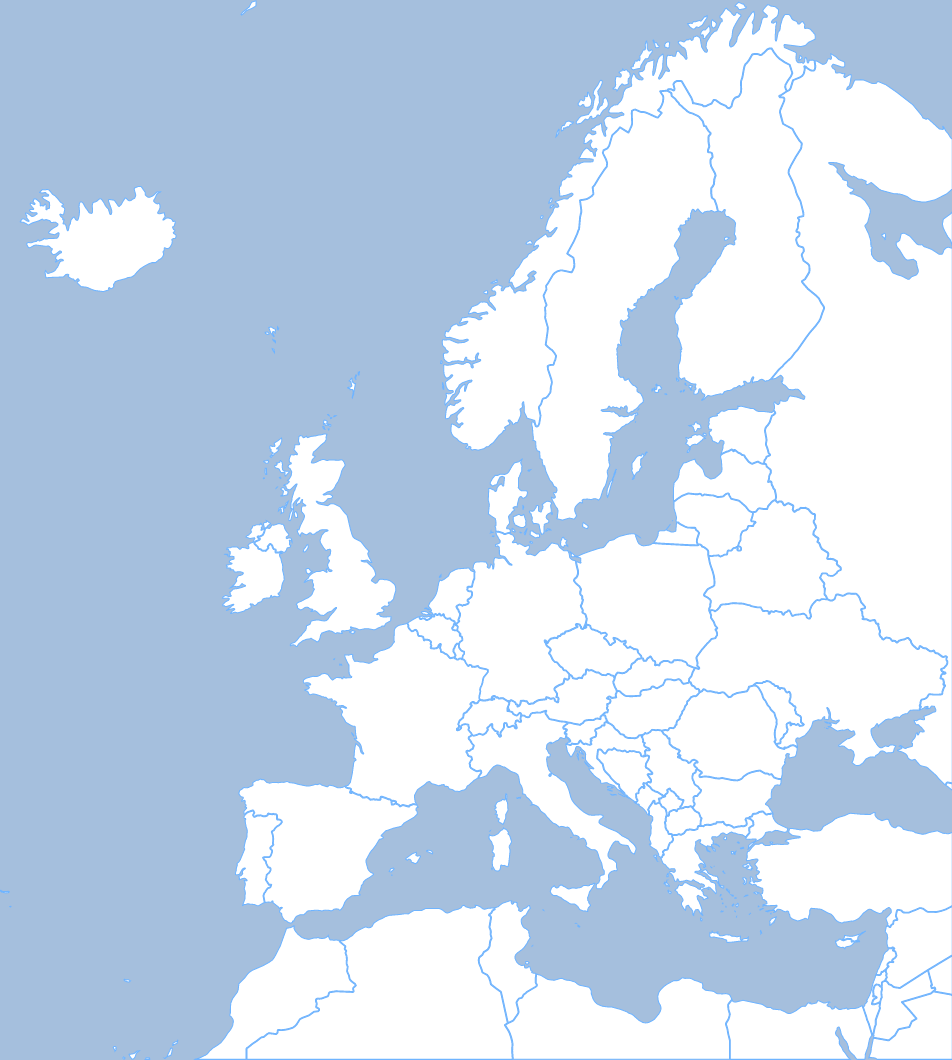
Map of Italian-speaking countries showing lampstands | © Amana Trust
(click on or hover over the map to view map labels)
Present-day Italy, the birthplace of the Roman Empire, has been crucial in God’s move throughout the centuries.
Brother Lee says,
For Christ’s great accomplishments to be carried out, there was the need for the Roman Empire to be established…It was during the reign of Augustus that Christ was born. Luke 2:1 says, “And it came to pass in those days, that there went out a decree from Caesar Augustus, that all the world should be taxed.” (The World Situation and God’s Move, p. 10)
The Lord Jesus was born under the rule of the first formal Caesar of the Roman Empire. It was God’s ordination that the Roman Empire should be in control of the Mediterranean area during the time of Christ.
Brother Lee continues,
The order which Rome brought to that warring region made it possible for the Lord Jesus to be born peacefully into mankind. The Roman method of capital punishment, crucifixion, made possible the fulfillment of the prophecies concerning His death.
The spread of the gospel after the resurrection and ascension of Christ was greatly facilitated by the common language, the single rule, the roads, and the domestic order that Rome established.
The Roman Empire, then, was appointed by God to provide the situation in which redemption could be accomplished and the gospel spread. (The World Situation and God’s Move, pp. 11-12)
The Lord Jesus was born under the rule of the first formal Caesar of the Roman Empire, where the method of capital punishment—crucifixion—eventually fulfilled the Old Testament prophecies concerning the Lord’s death. The common language, relative situation of peace, and convenience of travel within the empire facilitated the spread of the gospel. Within three hundred years of the Lord’s birth, the Christian faith conquered the entire Roman Empire. Today all that is left of the Roman Empire is ruins, but in contrast, the believers today exist all over the earth, proving that the life of God is the power that overcomes everything.
During the apostles’ time, a church was raised up in Rome. Regarding the apostle Paul’s first visit to Rome, Brother Lee points out the following in the Life-study of Acts:
The Judaizers had tried to frustrate [Paul] from going to the Gentiles, but the Lord sovereignly brought Paul to Rome. It was a great matter in the ancient times to make a journey from Jerusalem to Rome. But the Lord brought Paul far into the Gentile world, even into the capital of the Roman empire. Paul must have been full of joy when he arrived in Rome. Outwardly he was in bonds, but inwardly he was full of glory and unspeakable joy.
Paul’s being in Rome was a strengthening to the church in Rome, in particular because a good number of Jews had been saved. Paul came to Rome not too long after writing his Epistle to the Romans. A few years after writing this Epistle, he, the writer, came to Rome.
Acts 28:30 says, “And he remained two whole years in his own rented dwelling, and welcomed all those coming in to him.” During this time the apostle wrote the Epistles to the Colossians (cf. Col. 4:3, 10, 18), Ephesians (cf. 3:1; 4:1; 6:20), Philippians (cf. Phil. 1:7, 14, 17), and Philemon (cf. Philem. 1, 9). In Philippians 1:25 and 2:24 and Philemon 22 Paul was expecting to be released from his imprisonment. Probably after two years he was released. (pp. 619-621)
During Paul’s final imprisonment in Rome, he wrote the Second Epistle to Timothy (2 Tim. 1:16-17). It is also believed that Peter wrote his second Epistle from Rome near the time of his martyrdom.
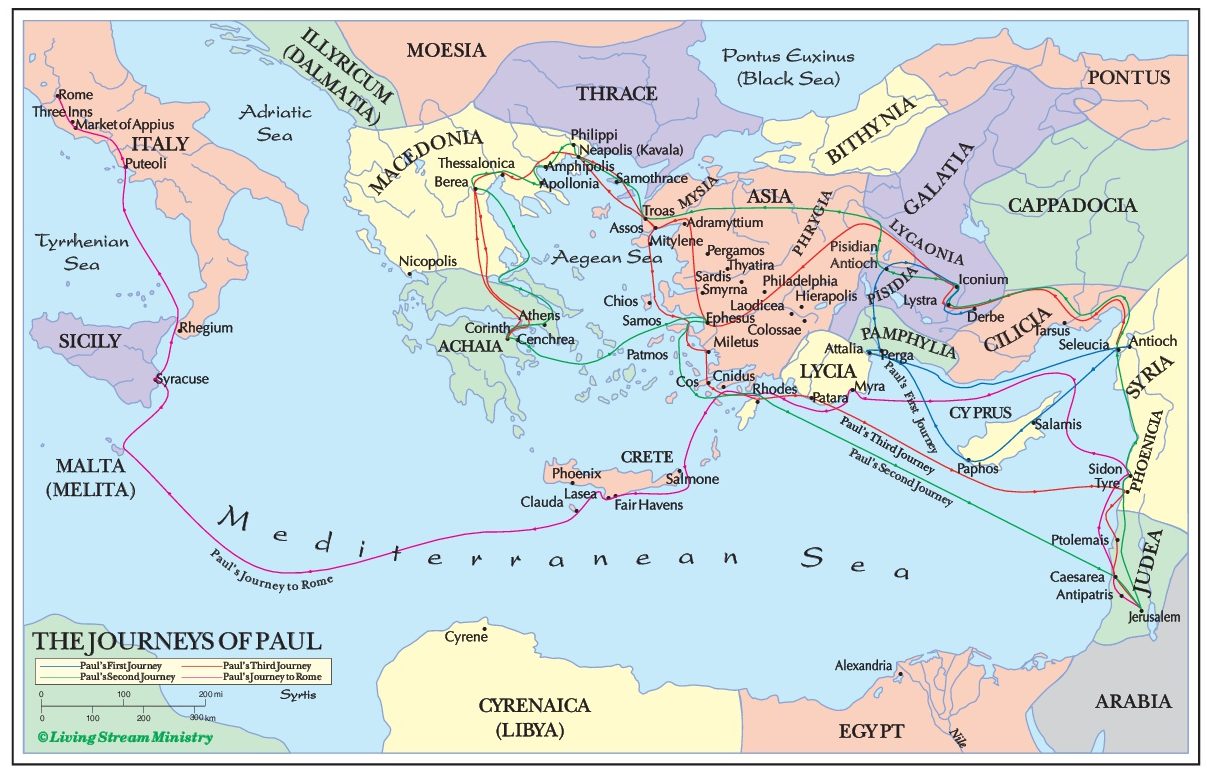
The Journeys of Paul | © Living Stream Ministry.
Used with permission. Do not duplicate.
After this time the church degraded to the extent that it was joined to worldly political powers, specifically to the Roman Empire. Rome has remained the center of the Roman Catholic Church, and Vatican City, situated within Rome, is the headquarters of the pope. In Italy there were dissidents from the Catholic Church since the twelfth century, but most of them were eliminated through persecution. One of the most important ones, Savonarola, led a reformation in Florence a couple of decades before the raising up of Martin Luther. By the 1500s there was further development, involving Calvinism and Anabaptism, especially in northern Italy, in part due to the influence from Germany. It was during this time that the Bible was first translated into Italian from Hebrew and Greek sources by Giovanni Diodati. Unfortunately, the Italian Reformation collapsed after only seventy years of existence, because of the Inquisition instituted by the Catholic Church. However, a small group of Waldensians, a reformist group that predated the Reformation, survived in the Alps of Italy. There, they focused on the Bible, took Christ as the center of their faith, preached the gospel, lived a simple life, and met from house to house. Despite the constant persecution, they stood against the degradation of the church even in the Middle Ages.
In 1871 the diverse states in the Italian peninsula were annexed and unified into the Kingdom of Italy; however, the Catholic Church resisted incorporation into the new nation, even though their land holdings were greatly reduced. The Lateran Treaty was signed in 1929, which settled the “Roman Question,” a dispute concerning the temporal power of the pope as owner of civil territory. This created the state of Vatican City and guaranteed full and independent sovereignty over the state to the Catholic Church. Despite the close association between Italy and Catholicism, the Constitution and an agreement signed in 1984 allowed non-Catholics to practice their faith freely.
In the late 1970s and early 1980s the Lord’s recovery first reached the bilingual area in northern Italy through German-speaking saints. As a result of the rebellion in 1989, the fellowship between the churches was stopped. A couple from England had a burden for Rome and Italy, and with a brother, who was a native Italian speaker from Naples, they were also burdened for the translation work into Italian. However, before the burden could be realized, one of the brothers went to be with the Lord. The other brother continued with the translation of ministry books for a while but eventually had to move to another country.
From 2002 onward a couple living in Switzerland began to distribute free English Recovery Versions of the New Testament in Italy. They also visited saints in Milan, Verona, and Vicenza, who were mainly from South America, Africa, and Romania. Later, more saints from China, the Philippines, and Romania moved to Rome, Florence, Catania, Naples, and Turin and were contacted by them through different sources. Through this labor the church in Milan was raised up in 2009 with mostly native Chinese-speaking saints who had moved to Italy for work and business purposes. In 2008 this couple began to pick up the burden for the Italian publication work with the saints in Italy and other countries.
The ministry became available in Italian on the Rhema website in 2011. Around the same time several families migrated to Rome, along with a young brother. They began to practice the church life with a number of brothers and sisters who had been in the church life in their own countries and were now living and working in diverse areas of Rome but were not meeting regularly. The newly migrated saints began to shepherd these saints and to preach the gospel on the university campuses.
After almost a year of regular weekly meetings, the saints became very burdened to have the Lord’s table as the testimony of Jesus in Rome. After fellowship with the leading brothers in the UK and the US, the decision was made to begin to have the Lord’s table in Rome, starting on June 17, 2012. To celebrate the resumption of the Lord’s table meeting on the genuine ground of oneness, over six hundred saints from all over the earth came together in Rome for a conference.
After the book fair in Turin, a Christian distributor began to distribute twenty-one Italian ministry books of Watchman Nee and Witness Lee in ten Christian bookstores in Italy and Switzerland in 2015. In 2016, by the Lord’s sovereignty, an Italian brother in Naples, who had been reading Watchman Nee’s books, contacted the saints in Rome. Through him the saints were brought in contact with a group of Italian believers who are now enjoying the fellowship in the recovery. Currently, there are about two hundred fifty saints in many different cities of Italy.
The Lord has been moving further in Italy. Besides Milan and Rome, other cities such as Turin, Vicenza, Padova, Florence, and Naples, where saints have been meeting regularly, are looking forward to establishing shining lampstands through the fellowship and perfecting in the Body. Recently, many native Italians have been contacted by the saints, and the ministry has opened a door for the Lord to flow in various cities. The saints are in prayer, fellowship, and coordination regarding how to shepherd these seeking ones into the Body step by step. In order to reach out to more seekers and to supply the saints, the literature work plans to increase distribution of the ministry through more channels and locations. There are also plans to release more hymns as well as the first Life-study messages, and to prepare to translate the Recovery Version of the New Testament in the next few years. At this moment, there are about sixty children, young people, and college students who are in the church life. They need to receive care in the homes and more training in order to become useful vessels for the Lord in the future. For the coming years, there is a burden of prayer that the Lord will thrust out the workers into His harvest.