The Recovery of the Truth
However, the Lord enlightened some in Europe to rise up and protest the situation of degraded Christianity.
John Wycliffe (mid-1320s-1384) was a scholar at Oxford who stood up against the corruption of the Catholic Church and advocated for the translation of the Bible into the vernacular, the common everyday language of people.

Portrait of John Wycliffe | Source
His writings influenced John Huss (1369-1415) in Bohemia, a region in what is now the Czech Republic, to focus on the Scriptures and expose the degradation of the apostate Catholic Church. Huss’s preaching and writing radically affected the region of Bohemia, which formed the basis for the Moravian Brethren three hundred years later.

Portrait of John Huss (Jan Hus) | Source
Brother Lee says in The Testimony and Ground of the Church,
Before Martin Luther, there were some who were quite enlightened and who rose up to speak for God in protest to degraded Christianity. Two of the most powerful ones were John Wycliffe on the British Isles and John Huss on the Continent. Both of them were very strong, and the light they received from the Bible was also quite clear. Before the time of Luther, they rose up and told people that the Roman Catholic Church was an apostate church, that she had left the revelation of God, and that her actions were completely against God; under her, they said, the church had become completely degraded. They gave numerous illustrations and released much light, and their words were received by many people. In their time, they laid a very good foundation for the Reformation. (p. 210)
Martin Luther (1483-1546) was familiar with John Huss’s writings early in his monastic career in Germany, was strongly influenced by German medieval mystics and Augustine, and became greatly impacted by the apostle Paul’s writings.
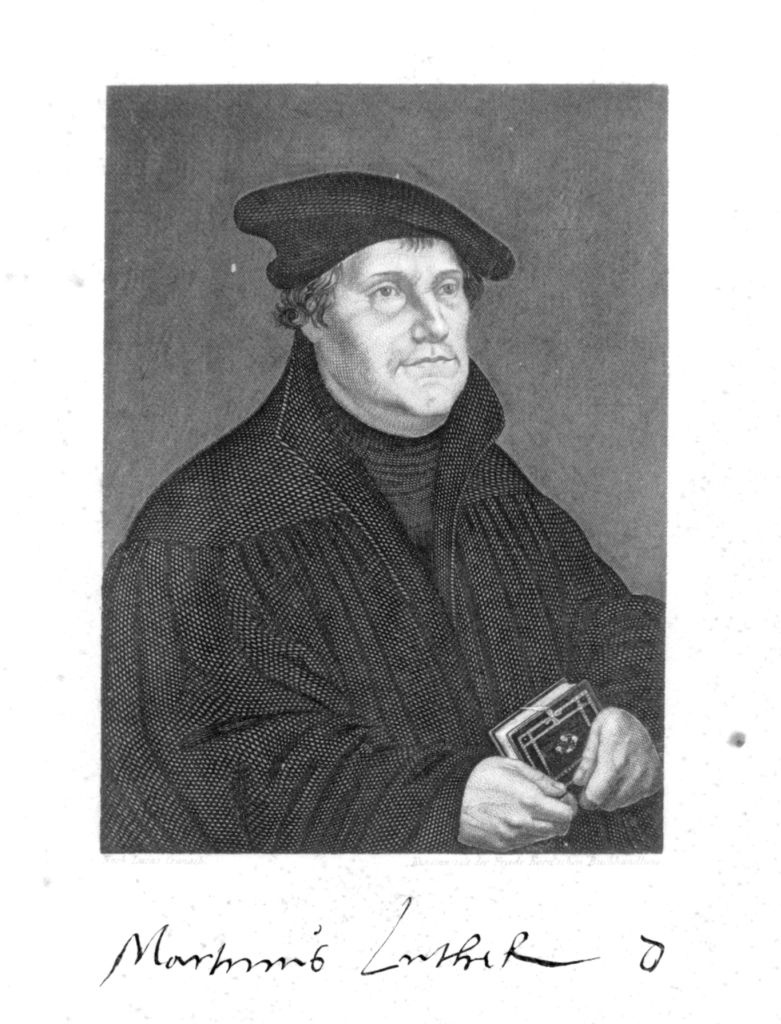
Portrait of Martin Luther | Source
As he studied the book of Romans during the 1510s, he realized the truth of justification by faith. Romans 1:17 was the key verse that sparked the Reformation in Europe—“But the righteous shall have life and live by faith.” Justification was not through the sacraments, rituals, or assenting to the teachings of the Catholic Church, but through faith, which is given by God. In 1517, when a Catholic preacher came to Germany selling indulgences to raise money for St. Peter’s Basilica in Rome, Luther protested by writing his 95 Theses. This act marked the beginning of the Reformation. From this point onward, the Lord would use many saints in Europe to recover one truth after another.
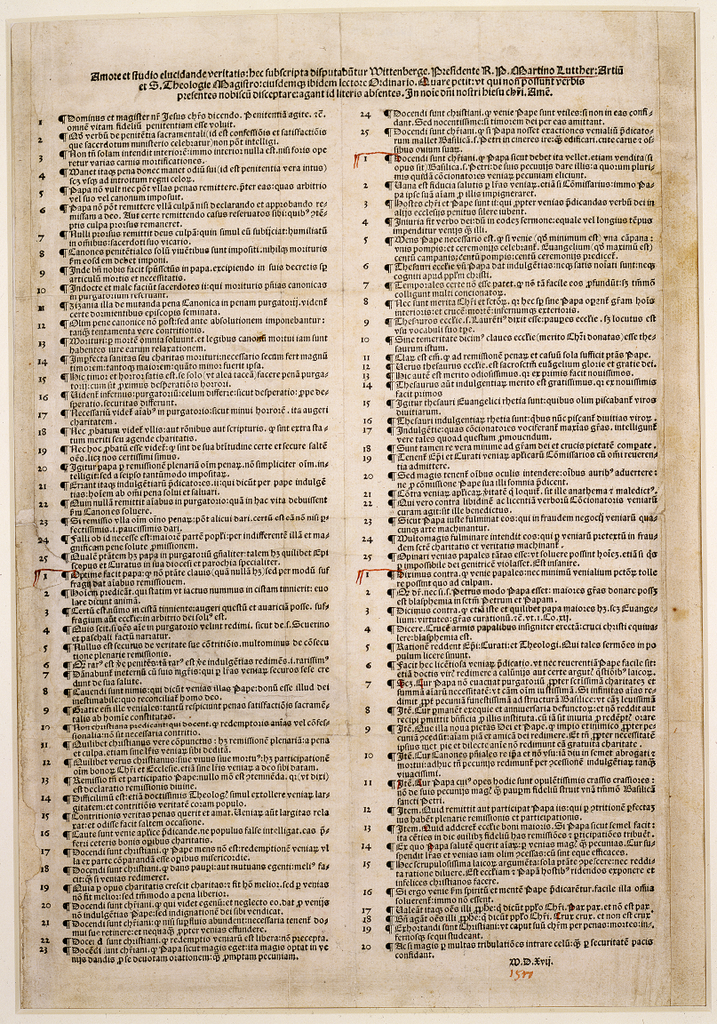
Martin Luther’s 95 Theses | Source
Ultimately, as Brother Lee points out, the most worthwhile and precious matter that Luther recovered was to open the Bible to the people by translating it into the German vernacular:
In the Reformation the first thing Luther did was to open the Bible to the public. He released the Bible completely so that everyone had a Bible in their hands to read. This is the most worthy thing of the reformation, and it is also the most beneficial thing to later generations. Some have said that justification by faith was the first thing recovered in Luther’s Reformation, but justification by faith is not the center of the Reformation. The most important item of the Reformation was the recovery of the open Bible. Luther’s recovery of justification by faith was based upon what he found in the open Bible. Therefore, the most precious item given to us by the Reformation was the open Bible. The second item was justification by faith, which was derived from the first. Although the Bible was made available to the public, not much of it was opened up, interpreted. (The Testimony and the Ground of the Church, pp. 211-212)
About the same time as the Reformation, movable type was invented in Europe…The reformers made use of the printing press to publish the truths they had seen. The Bible also could be printed instead of being copied by hand. As a result, it was spread among the people. Formerly it had been locked up by the Catholic Church. Martin Luther unlocked it. But the Bible was not opened up much; it was read but not really understood. (The World Situation and God’s Move, p. 65)
Sixty-two years before the publication of the 95 Theses, Johannes Gutenberg had printed the Bible (Latin translation) in western Germany on his printing press.
Gutenberg and his printing press | Source
Gutenberg’s invention of movable type was sovereignly prepared by God to facilitate the spreading of Luther’s translation of the Bible in Germany, the translation of the Bible in other European languages, and the publishing of new revelations seen during the Reformation. This move of the Lord spread throughout Europe: the Hussites were active and at one point gained almost all of the inhabitants in the region that is the present-day Czech Republic; John Calvin, who saw the revelation of God’s predestination, and Zwingli were raised up in Switzerland; the Reformation spread to the Nordic countries; and Henry VIII in England was influenced by reformers to split from the Catholic Church.
While Luther and the other reformers were bold to stand for the truths they had seen, they were weak in their standing for the church. As a result, they acquiesced in joining the church with secular authority and formed the state churches, which are prevalent in northern Europe.
Regarding Martin Luther’s legacy, Brother Lee says in The History of the Church and the Local Churches,
At the time of the Reformation, the Lord’s recovery came into a definite form. Martin Luther was a great servant of God. The Lord used him to recover the truth concerning justification by faith and to make the Bible open to the general public. Thank the Lord that justification by faith has been fully recovered. It will never be lost again. At the cost of his life, Luther stood for this truth, but when he came to the truth concerning the church, he was weak. He did not bring us back to God’s genuine intention to have the church life.
Luther realized that it was wrong to be joined with the German government, yet he still did it. Due to this big mistake, the state churches were produced. Besides the Roman Catholic Church and the Greek Orthodox Church, there are also the state churches. All the state churches are Lutheran churches except the Church of England, which is an Episcopal church. The German state church, the Danish state church, the Norwegian state church, the Swedish state church, and the Anglican state church were the issue of the seed sown by Luther. (p. 30)
However, some believers, like the Puritans in England (who later moved to America) and Anabaptists (who practiced baptism by immersion), dissented from the state churches and formed private churches. Many of these groups recovered an aspect of truth, but they would establish their own churches, resulting in division:
With the coming of the Reformation the Bible was released. This, coupled with the free thinking that developed once Catholicism’s hold on the mind was broken, led Christians to the discovery of many new truths in the Bible. It seemed that everyone who discovered a new truth became the founder of a new denomination…All these newly formed denominations were persecuted by both the Catholic Church and the state churches. This was true of the state churches even in northern Europe. These freethinking Christians were thus in peril for their lives. (The World Situation and God’s Move, p. 14)