Spain and Portugal
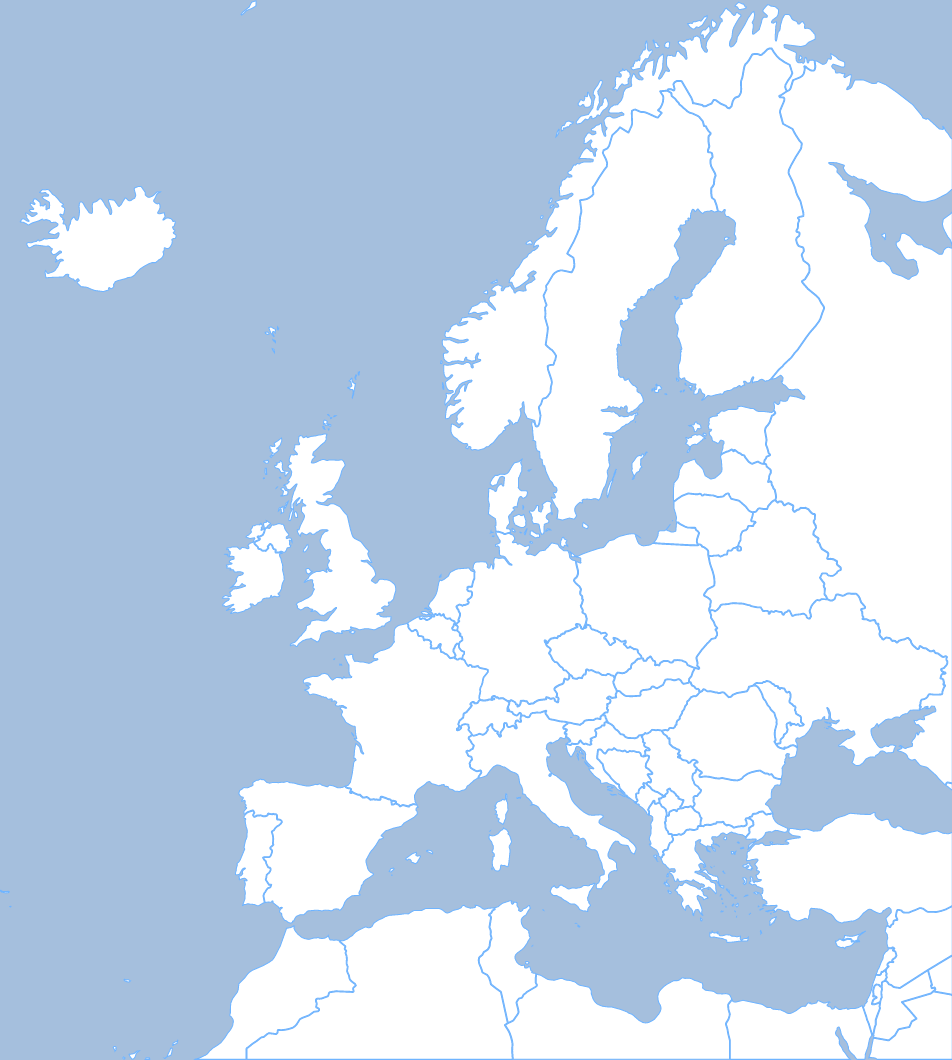
Map of the Iberian Peninsula showing Lampstands
(click on or hover over the map to view map labels)
The contents of this page are:
Spain
The New Testament mentions Spain twice, in Romans 15:24 and 28, where Paul expresses his desire to go to Spain, which was considered the uttermost part of the earth in his time.
The Iberian Peninsula was a province of the Roman Empire, and after its fall, Spain was invaded by the Visigoths, who had been Christianized as a result of their contact with Rome. In the year 711 Muslims from northern Africa invaded Spain and established a caliphate centered in Córdoba. Within a few decades they conquered practically the entire peninsula. However, a stronghold of Christians in northern Spain was left unconquered, and they eventually embarked on what is called in Spanish history the “Reconquista.”
After about eight centuries the Spanish monarchs Ferdinand II and Isabella I completed the return to Catholicism in 1492. That same year Queen Isabella funded Christopher Columbus’s voyage to the New World. The Spanish Empire and Catholicism spread to the Americas, and Spain became the leading world power in the sixteenth century. Simultaneously, the Reformation was spreading throughout Europe, and it was the Spanish monarch Charles I, the grandson of Isabella I and a staunch Catholic (also known as Charles V, Holy Roman Emperor), who presided over the Diet of Worms in 1521, where Martin Luther was called upon to retract his writings and to recant its “heresies.” Luther refused and was declared an outlaw. Luther was saved from harm by a German prince who contrived a kidnapping and ensconced him in a castle where he translated the Bible into German in 1522.
Two decades later, when the Council of Trent convened in 1545, Charles V’s influence caused the start of the Counter-Reformation, giving rise to the period of Catholic resurgence in response to the Protestant Reformation. Major figures of the Counter-Reformation were Spanish, such as Ignatius of Loyola, who founded the religious order of the Jesuits, and the Spanish mystics Teresa of Ávila and John of the Cross, all of whom became important political forces during that time.
In 1588, after the decisive defeat of the large and seemingly invincible Spanish Armada by the smaller British navy, Spain lost its supremacy and declined in world influence, opening the way for the British to obtain imperial possessions all around the earth and to spread Protestantism through its missionaries.
Brother Lee says regarding this, in The World Situation and God’s Move,
Until the close of the sixteenth century, Spain was the leading power on earth. If she had remained on top, the whole world would be under Catholicism, as is the case with Latin America. God could not allow this. Therefore, He raised up the small island of Britain, and in 1588 the British navy dealt a fatal blow to Spain’s supremacy by defeating the larger, seemingly better equipped, Spanish Armada. (pp. 13-14)
During the years prior to the Reformation, Catholic Cardinal Cisneros (the personal confessor to Queen Isabella I), using his own funds, convened scholars from all over Europe and prepared and published the first polyglot Bible in 1514. It became known as the Complutensian Polyglot Bible, after the university which was founded by Cisneros and continues to be the largest university in Spain today. The New Testament contained the Latin Vulgate and Greek texts, and the Old Testament contained the Septuagint, the Latin Vulgate, and Hebrew texts.
With the onset of the Reformation and influenced by Luther’s teachings, a couple of Spanish monks in exile translated the Bible into Spanish and published what became known as the Reina-Valera version of the Protestant Bible in 1569. Due to the intolerance of the Spanish court and the Catholic Church in Spain toward any non-Catholic religion, the Reformation had very little impact in Spain and Portugal.
Protestantism in Spain made a comeback after the Glorious Revolution of 1868, resulting in the granting of greater religious liberties. These were rescinded under the dictatorship of Franco until his death in 1975. The 1978 Constitution of Spain and the Law of Religious Freedom of 1980 guarantee religious freedom. Therefore, at present there are an estimated 1.5 million Protestants in Spain.
In either 1981 or 1982 the recovery came to Spain through Gibraltar, after someone who had a pamphlet on the church caused some brothers to contact and fellowship with saints in Germany. Then a Spanish couple who found the recovery in Germany returned to live in Benalmádena, on the coast, and began meetings with those who had contacted Germany. At about the same time, a brother who was from Córdoba and working in Germany had met the recovery, and during a trip home, contacted two families in a Baptist group in Córdoba and shared with them about the church. Then this brother returned to Spain, and in 1984 they began meeting as the church in Córdoba. Because this brother knew those in Benalmádena when they were in Germany, the fellowship between Córdoba and Benalmádena began. There were by then about ten to twelve saints meeting in the church in Córdoba.
In 1985 an elder from a free group in Málaga went to do some work on a house of a brother in Benalmádena, and this brother shared with the elder about the Lord’s recovery. Soon after, the Málaga free group was having a retreat, and they invited the Benalmádena group. The saints from Benalmádena said that they would bring along a Chinese brother who was a follower of Watchman Nee and Witness Lee and that he could give the word, to which the Málaga group agreed. The subject of the talk was “The Full Ministry of Christ,” and the entire group was revolutionized. The result was that the two groups—Benalmádena and Málaga—came together to become the church in Málaga.
At about the same time, the recovery spread also to Huelva. A sister from Huelva met in the church in Málaga. She knew several families in Huelva who were believers, and in 1986 she and some other couples from Málaga went to visit them and to share with them about the church. The church in Huelva began with about three families.
From 1987 through 1989 there was a turmoil in the Lord’s recovery in Europe that resulted in divisions in Málaga and Córdoba. The saints in Spain were confused by what was happening and by the speaking of the brother from Germany, which initially had ministered much life but had now changed. Some of the saints then decided to detach themselves and meet again as a free group like before, but about twenty saints continued to meet as the church in Málaga, together with the saints originally from Benalmádena. Toward the close of the decade, all communication between the churches in Spain and Germany had stopped and at the same time, the saints in Spain were totally isolated from the Lord’s recovery in the US as a result of the negative speaking originating from Germany.
Just at that time, one of the brothers who went back to the free group attended a conference in Brazil where the Life-study of Leviticus was being shared. At the conference there was also sharing on what was happening in Germany and Europe. After this brother returned, he shared the audio messages with some of the brothers in the church in Málaga, and through these messages, the church in Málaga realized what was happening in Germany and Europe.
In early 1990 a sister from Anaheim was sent by Brother Lee to Málaga to find out what the situation was there. Upon realizing where this sister came from, one of the leading brothers invited her to his home for fellowship and asked her many questions. A couple from Córdoba was also present. This sister had brought with her literature of the ministry of Brother Lee and gave it to this brother. After reading the books, the brother testified that “the heavens were opened up again.” He realized that this was the same speaking that initially had come from Germany but which had changed in the past few years. After the visit by the sister from Anaheim, fellowship was established with a co-worker in Anaheim.
In the early 1980s, a Spanish brother, who was working in Mexico, was saved and came into the church life. In his past, he had been studying to be a priest but was not ordained because of what he saw in the Catholic Church. In spite of the opposition from his wife, who threatened to divorce him on account of his salvation and coming into the church, he remained firm in his newfound faith. In 1989 he returned to Spain with his family and joined himself to the church in Málaga. As a result of his steadfastness and testimony, eventually his wife also got saved and became a dear sister in the church life.
He and the leading brother who had invited the sister from Anaheim to his house decided to go on together and to faithfully follow the ministry. They began to study the book The Glorious Church by Watchman Nee, to follow the fellowship of the co-worker from Anaheim, to minister life, to only speak life and building, and to not enter into arguments. They invited the co-worker from Anaheim to come have fellowship, and he came, accompanied by two brothers from Puerto Rico as translators. Their speaking and visit greatly encouraged the saints. The brothers continued to blend and fellowship with the churches in Puerto Rico and the US, and in the 1990s a number of saints who had left the church life returned. The saints in Spain also began to attend trainings in Anaheim and conferences in London, which they do until this day. The young people also began joining the Poland Conference. A number of them entered the FTTL and became full-time serving ones in Madrid.
Currently about fifty saints meet in Málaga, with about another thirty to forty saints who are enjoying the ministry but who are scattered in the surrounding towns. In 1996, due to a gospel tract, the church in Marbella was raised up. As the result of some attrition, currently there are only four saints in Marbella. A meeting in Dos Hermanas, a town outside Seville, was established in 1997. In 1999 a family was gained through the radio in the coastal town of Guadiaro, and they started to meet with others in that town.
Around 2002 some South American, Chinese, and Ethiopian believers, some of whom had been in the recovery, immigrated to Spain and were living in Madrid. These ones were scattered but came in contact with each other and began to meet. Then co-workers from the US and London began visiting them, and the church life was established. Today about seventy saints meet regularly in Madrid. Around 2005 and 2006 the church life began in Valencia through some saints who were in the recovery in Bolivia. Currently about thirty-five meet in Valencia.
The church in Barcelona, most of whom are Chinese-speaking, took the ground in March 2008. Currently there are about forty-five saints, although not all are able to meet every week as many live in surrounding towns and have businesses that are open during weekends.
In May 2010 the church in Murcia was established through a brother from Moldova. He contacted friends and believers who were all from different Russian-speaking countries, and they began to meet together in Russian. Subsequently, others from Germany, South America, and Spain were added to the church. About twelve saints meet there.
The church in Girona was established in February 2011 with about thirty saints. Due to some saints moving away for jobs, right now about twelve saints meet in Girona.
There are saints meeting on the island of Mallorca, and scattered saints in the cities of Santander, Bilbao, and Pamplona in Spain.
Portugal
In 1988 a brother in Vila Nova de Gaia, who was meeting with the Assembly of God, received on loan from another brother in his congregation the book The Spiritual Man by Watchman Nee. While reading it, he experienced something he had never experienced with any other book—his heart “burned,” just like the disciples on the road to Emmaus when the Lord opened the Scriptures to them. He read all he could by Brother Nee, and when he read Further Talks on the Church Life, he realized that he had to leave his denomination and stand on the proper ground of the church. He began meeting with his family in his home but sought to find out if other believers met according to the vision of the church that he had seen from Brother Nee’s ministry. Eventually, he got in contact with brothers in Brazil from an address on the Portuguese books and went to a conference there. However, nothing was mentioned to this brother at that time about the Lord’s move in Europe. In the meantime and through speaking what he had seen in the ministry of Watchman Nee and Witness Lee to some fellow believers, the number of saints in Portugal grew to nearly thirty saints. In 1998, nearly four years after the saints had started meeting as the church in Vila Nova de Gaia, through the Lord’s wonderful operation a sister who had just moved to Galicia (in northern Spain, two and a half hours from Vila Nova de Gaia) got in contact with this group of saints. She told them about the churches in Spain and led them to meet with the saints there. Contact with the saints in Spain was established in August 1998. In December 1998 the saints in Portugal attended the conference in Malaga and established contact with the saints in Europe and the US. At this time, there are saints meeting in Vila Nova de Gaia and São João da Madeira. There are also some Bulgarian saints in Cascai and recently some saints from Brazil have immigrated to Portugal and are living nearby Lisbon who are in contact with the saints in Vila Nova de Gaia and São João da Madeira. Two saints are currently attending the Full-time Training in London, and over the past ten years five saints have graduated from the training.
The Iberian Peninsula today has brothers’ and sisters’ fellowships, young people’s conferences, a children and family camp, and the winter school of truth. There are currently ten localities in the Peninsula that have the table meeting and about three hundred fifty saints in total. Propagation continues to be carried out through radio broadcasting of the Life-studies and distribution through Rhema and Bibles for Europe.
Looking forward, we have a “pipeline” of children and young people whom we are shepherding on the need to pursue the Lord with their companions, to have a good education, and to learn English with a view to attending the full-time training. We currently have nine church-kid university students in two cities whom we hope to be candidates for the FTTL. We also have two current FTTL trainees and look to the Lord for their future usefulness to Him for His move in the Peninsula. We are also moving forward with fellowship to raise up some middle-age full-time serving ones to labor in the reaping of many radio, Rhema, and Bibles for Europe contacts, as well as to shepherd the scattered and isolated saints.